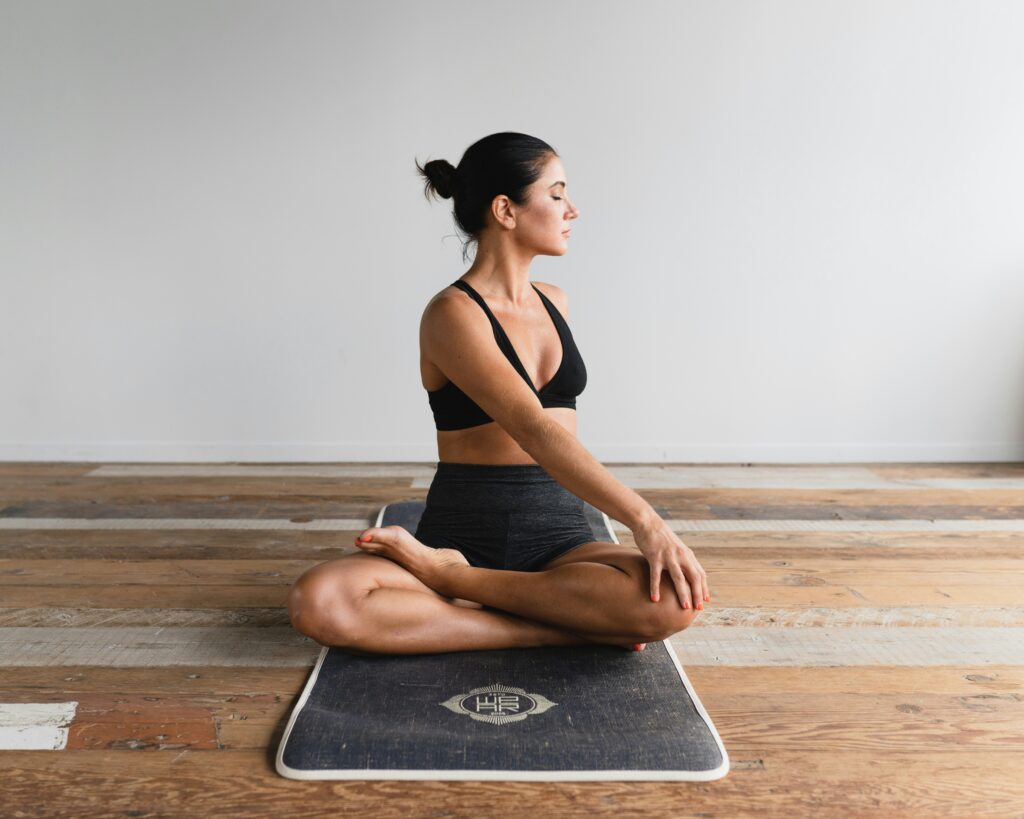
1. Introduction: Balancing Force with Flexibility
In the fitness world, people often segregate themselves into two groups: the weightlifters and the yogis. However, at FitCoreLogic, we see this as a missed opportunity for peak performance. Pure strength without flexibility leads to stiffness and injury, while pure flexibility without strength leads to instability. The “Perfect Hybrid” approach combines the external force of strength training with the internal control of yoga. Logically, these two disciplines are not opposites; they are the two halves of a complete human machine.
2. The Logic of Increased Range of Motion
The primary reason strength trainees should practice yoga is to improve their “Active Range of Motion” (ROM). If your muscles are too tight, you cannot perform a squat or an overhead press with the correct form, which limits your strength gains and puts undue stress on your joints. Yoga poses, such as the “Downward Dog” or “Pigeon Pose,” logically lengthen the muscles and connective tissues. This increased mobility allows you to lift weights through a fuller range, leading to better muscle fibre recruitment and superior results.
3. Stability: Strengthening the “Core Logic”
While yoga is famous for stretching, it is secretly a powerhouse for isometric strength and stability. Holding a “Warrior III” or a “Tree Pose” requires incredible coordination between the deep core muscles and the stabilisers in your ankles, knees, and hips. For the professional lifter, this translates to better balance during heavy compound movements. By training these smaller, often neglected muscles through yoga, you create a more “stable” foundation, which logically allows you to lift heavier loads safely.
4. Recovery and the Parasympathetic Nervous System
Heavy strength training is a “stressor” that activates the Sympathetic Nervous System (the fight-or-flight response). If you stay in this state too long, you risk burnout. Yoga, specifically through focused “Pranayama” (breathwork), activates the Parasympathetic Nervous System—the body’s “rest and digest” mode. The logic here is recovery speed. By incorporating yoga, you clear metabolic waste faster and lower cortisol levels, ensuring that your body returns to an anabolic (building) state more quickly after a brutal gym session.
5. Mind-Muscle Connection and Focus
Yoga requires a high level of proprioception—the awareness of where your body is in space. This heightened “Mind-Muscle Connection” is a powerful tool for the boardroom and the gym. When you learn to control your breath and focus your mind during a difficult yoga hold, you are training the mental discipline required to grind through a difficult set of deadlifts or a high-pressure business presentation. It is the ultimate logical exercise in mental and physical synchronisation.
6. Designing Your Hybrid Schedule
You don’t need to spend hours on a yoga mat to see the benefits. The most logical way to integrate yoga into a strength programme is to use it as a “Bookend” or a “Recovery Day” activity. A 10-minute yoga flow before training can act as a dynamic warm-up, while a longer session on a rest day can serve as active recovery. At FitCoreLogic, we believe that true fitness is about being “strong enough to be powerful, and flexible enough to be graceful.”
| Feature | Strength Training | Yoga Practice | The Hybrid Result |
| Primary Focus | Force & Power | Flexibility & Balance | Functional Resilience |
| Muscle Action | Contraction (Shortening) | Extension (Lengthening) | Balanced Muscle Tone |
| Nervous System | Sympathetic (Alert) | Parasympathetic (Calm) | Faster Recovery |
| Joint Health | Increases Bone Density | Improves Lubrication | Long-term Mobility |
| Breathing | Bracing (Valsalva) | Fluid (Ujjayi) | Better Oxygen Control |
Frequently Asked Questions (FAQs)
Q: Will yoga make me lose my muscle mass?
A: Not at all. In fact, by improving your recovery and range of motion, yoga can actually help you build more muscle by allowing you to train harder and more frequently without injury.
Q: I am very stiff; can I still do yoga?
A: Saying you are too stiff for yoga is like saying you are too dirty for a bath. Being stiff is exactly why you should do it. Start with basic modifications; the logic is progress, not perfection.
Q: Should I do yoga before or after lifting weights?
A: Short, dynamic yoga movements are great for a warm-up. Longer, deep-holding stretches are logically better after your workout or on a separate day to avoid over-relaxing the muscles before a heavy lift.
Q: Do I need a teacher, or can I do it at home?
A: For busy professionals, home-based yoga via apps or videos is perfectly logical. However, attending a few classes to learn the basic “alignment logic” is highly recommended to avoid mistakes.
About the Author